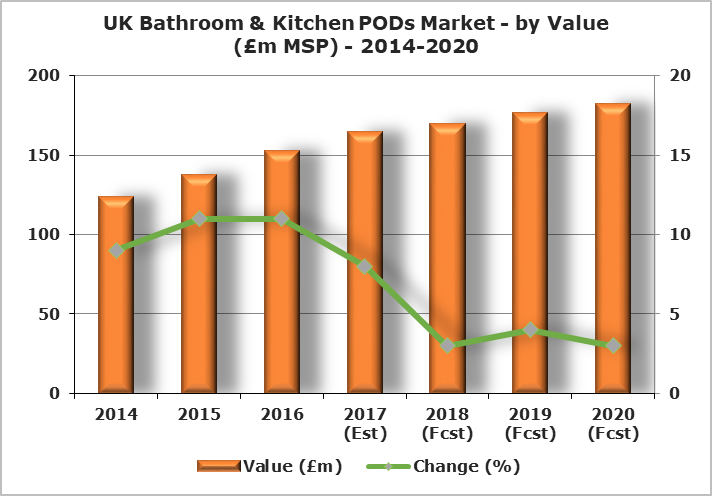
The UK market for bathroom and kitchen PODs market was estimated to have grown by 4% in 2017, in terms of the volume of POD installations. The market also saw an 8% increase in value, which can partly be attributed to higher prices for steel and GRP resin being passed on. There has also been some growth in demand for higher specification PODs in the luxury apartment and upmarket hotel sectors, which has contributed towards value growth.
Overall demand for PODs has been driven by a combination of factors; including demand for design standardisation and fast-track construction; ongoing key skills shortages; growth in the number of sites where there is restricted space; and increasing demand in the main end-user markets. The key sectors where PODs are used are; purpose-built student accommodation (PBSA), hotels and apartment blocks. Between them, these three sectors account for over 80% of installations, while the remainder of the market is split between hospitals, care homes, MoD accommodation and custodial buildings.
The largest area of demand for bathroom and kitchen PODs is in purpose-built student accommodation in medium-high rise steel and concrete mainframe buildings. In the hotel industry, clients will often specify offsite building methods to achieve fast turnarounds to enable occupation as quickly as possible, and for many of the major hotel brands, a need for high levels of standardisation in design is also important. In the apartments sector, there has been extensive use of bathroom and kitchen PODs on both social housing and luxury, high-rise developments.
By value, PODs manufactured from either glass reinforced plastic or composite (GRP) account for the largest share of the market, closely followed by steel frame, while concrete and other materials, such as timber, account for lower shares. GRP PODs are mostly used in PBSA and budget hotel rooms, while in higher specification developments concrete or steel PODs are typically preferred.
Kitchen PODs account for less than 10% of the market, the core application being multioccupancy residences such as purpose-built student accommodation, holiday resorts, military barracks and apartment blocks. Other areas of application include permanent and temporary use at hospital sites and as temporary stand-alone modules for large-scale events.
Over the next five years, it is anticipated demand for PODs could grow steadily at a rate of 4- 5% per year, there being reasonably strong construction pipelines in key end-use sectors, although the uncertainty surrounding the Brexit negotiations may have some negative impact on demand. On the other hand, associated skills shortages may also lead to an increase in demand for offsite solutions and contribute towards growth in the PODs sector.
The urgent need for more affordable and rented housing in London and other major urban areas is expected to continue to drive demand for fast-build apartment blocks, while the hotel sector in London and other major cities should continue to provide impetus for growth in demand for bathroom PODs in the medium term, although a substantial proportion of schemes will be conversions.
Despite a high level of PBSA development in some cities, such as Leeds and Manchester, a relatively large proportion of student halls built in the 1960s/1970s are now reaching their end of life and in need of redevelopment. There also remains an ongoing shortage of high-quality accommodation in many cities, suggesting there is still an urgent need for PBSA, and predicted strong future build levels in this sector should continue to drive demand for PODs.
The ‘Bathroom and Kitchen PODs Market Report – UK 2018-2022’ report is available now and can be ordered online at www.amaresearch.co.uk or by calling 01242 235724.
Showing posts with label Market research. Show all posts
Monday, 20 August 2018
Monday, 20 November 2017
UK commercial and industrial doors market regains pre-recession level
The commercial and industrial doors market increased by an estimated 3% in 2016, following 4% growth in 2015, though there are indications that the growth rate is slowing in 2017.
Key factors underpinning growth in the market have included the increase in private commercial and industrial new build and non-residential RMI since 2012. While the market for industrial doors regained their pre-recession level in 2016, commercial and personnel access doors remain nearly 7% below its 2008 peak.
Sub-sectors within manufacturing such as transport, aviation and food production, have helped sustain construction demand for a variety of door products - from high insulated systems for refrigerated units, to large transport warehouse industrial doors. The chemicals and pharmaceuticals sectors also require very high-quality door systems and materials including high value specialised hygienic products developed for use in these industries. Changes to building regulations and increased requirements in terms of security, as well as sustainability issues, have also helped to assist market growth with increasing emphasis placed on higher-quality products.
The market for personnel doors is directly related to commercial and industrial new build and RMI demand, which declined between 2008 and 2012, but has seen continuous annual growth since 2013. In overall terms, the industrial doors market has demonstrated erratic trends at times with demand sometimes bucking an otherwise falling economic trend with rising demand. More importantly, an underlying steady level of servicing and maintenance expenditure has also contributed towards smoothing out demand.
Jane Tarver of AMA Research commented: “The market outlook for commercial and industrial doors over the next few years is positive, but forecasts indicate only modest growth in the short-medium term, based on a slowing trend of new construction orders and the uncertainty affecting business confidence and investment levels as a result of the Brexit process.”
Short-medium term prospects in construction activity in 2017/18 have gone from modestly optimistic to ‘relatively cautious’, with variations between construction sectors. Modest growth is currently forecast in the leisure and industrial sectors but with the commercial offices and retail sectors forecast to show short-term decline as they come under pressure reflecting reduced confidence and investment levels.
Given the above background, the forecasts are that the commercial and industrial doors and shutters sector will show low to modest annual growth from 2016-21, with only 6% overall value growth currently forecast 2016-2021.
Demand will continue to focus on automated systems, more energy saving and security door systems, and for sustained RMI work across sectors leading to some market growth in the replacement market, while new build volumes for both personnel access doors and industrial doors will see lower rates of growth. Product innovations and increased security and insulation properties for both personnel access and industrial doors are also likely to be key factors underpinning market value into the medium-term.
The report (Commercial and Industrial Doors and Shutters Market Report – UK 2017-2021 Analysis) is available now and can be ordered online at www.amaresearch.co.uk or by calling 01242 235724.
Photo: Via Shuttestock
Key factors underpinning growth in the market have included the increase in private commercial and industrial new build and non-residential RMI since 2012. While the market for industrial doors regained their pre-recession level in 2016, commercial and personnel access doors remain nearly 7% below its 2008 peak.
Sub-sectors within manufacturing such as transport, aviation and food production, have helped sustain construction demand for a variety of door products - from high insulated systems for refrigerated units, to large transport warehouse industrial doors. The chemicals and pharmaceuticals sectors also require very high-quality door systems and materials including high value specialised hygienic products developed for use in these industries. Changes to building regulations and increased requirements in terms of security, as well as sustainability issues, have also helped to assist market growth with increasing emphasis placed on higher-quality products.
The market for personnel doors is directly related to commercial and industrial new build and RMI demand, which declined between 2008 and 2012, but has seen continuous annual growth since 2013. In overall terms, the industrial doors market has demonstrated erratic trends at times with demand sometimes bucking an otherwise falling economic trend with rising demand. More importantly, an underlying steady level of servicing and maintenance expenditure has also contributed towards smoothing out demand.
Jane Tarver of AMA Research commented: “The market outlook for commercial and industrial doors over the next few years is positive, but forecasts indicate only modest growth in the short-medium term, based on a slowing trend of new construction orders and the uncertainty affecting business confidence and investment levels as a result of the Brexit process.”
Short-medium term prospects in construction activity in 2017/18 have gone from modestly optimistic to ‘relatively cautious’, with variations between construction sectors. Modest growth is currently forecast in the leisure and industrial sectors but with the commercial offices and retail sectors forecast to show short-term decline as they come under pressure reflecting reduced confidence and investment levels.
Given the above background, the forecasts are that the commercial and industrial doors and shutters sector will show low to modest annual growth from 2016-21, with only 6% overall value growth currently forecast 2016-2021.
Demand will continue to focus on automated systems, more energy saving and security door systems, and for sustained RMI work across sectors leading to some market growth in the replacement market, while new build volumes for both personnel access doors and industrial doors will see lower rates of growth. Product innovations and increased security and insulation properties for both personnel access and industrial doors are also likely to be key factors underpinning market value into the medium-term.
The report (Commercial and Industrial Doors and Shutters Market Report – UK 2017-2021 Analysis) is available now and can be ordered online at www.amaresearch.co.uk or by calling 01242 235724.
Photo: Via Shuttestock
Subscribe to:
Posts (Atom)

