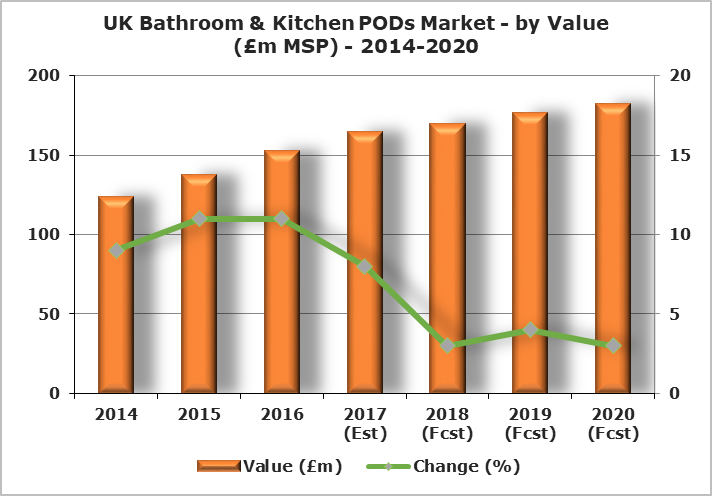
The UK market for bathroom and kitchen PODs market was estimated to have grown by 4% in 2017, in terms of the volume of POD installations. The market also saw an 8% increase in value, which can partly be attributed to higher prices for steel and GRP resin being passed on. There has also been some growth in demand for higher specification PODs in the luxury apartment and upmarket hotel sectors, which has contributed towards value growth.
Overall demand for PODs has been driven by a combination of factors; including demand for design standardisation and fast-track construction; ongoing key skills shortages; growth in the number of sites where there is restricted space; and increasing demand in the main end-user markets. The key sectors where PODs are used are; purpose-built student accommodation (PBSA), hotels and apartment blocks. Between them, these three sectors account for over 80% of installations, while the remainder of the market is split between hospitals, care homes, MoD accommodation and custodial buildings.
The largest area of demand for bathroom and kitchen PODs is in purpose-built student accommodation in medium-high rise steel and concrete mainframe buildings. In the hotel industry, clients will often specify offsite building methods to achieve fast turnarounds to enable occupation as quickly as possible, and for many of the major hotel brands, a need for high levels of standardisation in design is also important. In the apartments sector, there has been extensive use of bathroom and kitchen PODs on both social housing and luxury, high-rise developments.
By value, PODs manufactured from either glass reinforced plastic or composite (GRP) account for the largest share of the market, closely followed by steel frame, while concrete and other materials, such as timber, account for lower shares. GRP PODs are mostly used in PBSA and budget hotel rooms, while in higher specification developments concrete or steel PODs are typically preferred.
Kitchen PODs account for less than 10% of the market, the core application being multioccupancy residences such as purpose-built student accommodation, holiday resorts, military barracks and apartment blocks. Other areas of application include permanent and temporary use at hospital sites and as temporary stand-alone modules for large-scale events.
Over the next five years, it is anticipated demand for PODs could grow steadily at a rate of 4- 5% per year, there being reasonably strong construction pipelines in key end-use sectors, although the uncertainty surrounding the Brexit negotiations may have some negative impact on demand. On the other hand, associated skills shortages may also lead to an increase in demand for offsite solutions and contribute towards growth in the PODs sector.
The urgent need for more affordable and rented housing in London and other major urban areas is expected to continue to drive demand for fast-build apartment blocks, while the hotel sector in London and other major cities should continue to provide impetus for growth in demand for bathroom PODs in the medium term, although a substantial proportion of schemes will be conversions.
Despite a high level of PBSA development in some cities, such as Leeds and Manchester, a relatively large proportion of student halls built in the 1960s/1970s are now reaching their end of life and in need of redevelopment. There also remains an ongoing shortage of high-quality accommodation in many cities, suggesting there is still an urgent need for PBSA, and predicted strong future build levels in this sector should continue to drive demand for PODs.
The ‘Bathroom and Kitchen PODs Market Report – UK 2018-2022’ report is available now and can be ordered online at www.amaresearch.co.uk or by calling 01242 235724.
Showing posts with label KBB sector. Show all posts
Monday, 20 August 2018
Monday, 23 July 2018
Inclusive KBB Market grows by 4%
The inclusive KBB market grew by 4% in 2017 compared with the previous year, according to AMA Research. Showering facilities, which includes easy-access enclosures and wet rooms, are the largest in this sector.
Multi-generational households have increased by 42% over the past decade, as affordable housing for the elderly has declined, meaning houses suitable for 4G living have become a large market for retailers and manufacturers.
AMA Research has attributed a ‘significant proportion’ of the inclusive KBB market to direct sales from specialist manufacturers to end-users.
After the decline of the construction industry in 2012, the inclusive KBB market has started to recover and has seen accelerated sales in 2014-2015 and continued its growth in 2016.
Hayley Thornley, market research manager at AMA Research said: “With an increasing number of elderly and disabled people in the UK, and the continued trend towards multigenerational households, the growing demand for inclusive bathroom and kitchen products looks set to continue. By 2022, the market value is forecast to have increased by 16% compared with the market size in 2017.”
The market for people with disabilities has increased as well. Inclusive kitchens that have been developed for wheelchair access tend to be custom-built solutions to specific requirements, which can include specialist products, such as rise-and-fall units, lever-operated or remote sensor taps to shallow depth sinks.
Samantha Ashwood, senior product group manager at Häfele, said: “The report substantiates our own experience in the inclusivity market where we have seen almost 32% year-on-year growth. The point about inclusive solutions becoming more aesthetically pleasing is certainly worth highlighting. Designers are rising to the challenge of coupling beautiful looks and finishes with robust, everyday practicality.
“We have some major customers taking our Ropox range of height-adjustable wall cupboards and worktop systems and there is a real focus on making spaces adaptable and usable for all.”
AMA Research shows that there is a growing demand for consumers to future-proof their houses as a way to add value to a property.
Ash Chilver, sales director at HiB, said: “The average bathroom has a long life cycle, so when homeowners invest in their space, they often look for options that will create a timeless elegance that won’t become dated after a couple of years. This has resulted in a growing trend for traditionally designed products with a contemporary flair.
“British homes are also getting smaller. The onus is therefore on homeowners to be smarter about their bathroom design. In view of this, products which can enhance the style of the bathroom whilst also providing a space-saving solution have become must-haves, making all the difference for homeowners.”
Image from Shutterstock
Multi-generational households have increased by 42% over the past decade, as affordable housing for the elderly has declined, meaning houses suitable for 4G living have become a large market for retailers and manufacturers.
AMA Research has attributed a ‘significant proportion’ of the inclusive KBB market to direct sales from specialist manufacturers to end-users.
After the decline of the construction industry in 2012, the inclusive KBB market has started to recover and has seen accelerated sales in 2014-2015 and continued its growth in 2016.
Hayley Thornley, market research manager at AMA Research said: “With an increasing number of elderly and disabled people in the UK, and the continued trend towards multigenerational households, the growing demand for inclusive bathroom and kitchen products looks set to continue. By 2022, the market value is forecast to have increased by 16% compared with the market size in 2017.”
The market for people with disabilities has increased as well. Inclusive kitchens that have been developed for wheelchair access tend to be custom-built solutions to specific requirements, which can include specialist products, such as rise-and-fall units, lever-operated or remote sensor taps to shallow depth sinks.
Samantha Ashwood, senior product group manager at Häfele, said: “The report substantiates our own experience in the inclusivity market where we have seen almost 32% year-on-year growth. The point about inclusive solutions becoming more aesthetically pleasing is certainly worth highlighting. Designers are rising to the challenge of coupling beautiful looks and finishes with robust, everyday practicality.
“We have some major customers taking our Ropox range of height-adjustable wall cupboards and worktop systems and there is a real focus on making spaces adaptable and usable for all.”
AMA Research shows that there is a growing demand for consumers to future-proof their houses as a way to add value to a property.
Ash Chilver, sales director at HiB, said: “The average bathroom has a long life cycle, so when homeowners invest in their space, they often look for options that will create a timeless elegance that won’t become dated after a couple of years. This has resulted in a growing trend for traditionally designed products with a contemporary flair.
“British homes are also getting smaller. The onus is therefore on homeowners to be smarter about their bathroom design. In view of this, products which can enhance the style of the bathroom whilst also providing a space-saving solution have become must-haves, making all the difference for homeowners.”
Image from Shutterstock
Saturday, 18 February 2017
Kitchens are getting bigger and bigger says new Houzz report
Houzz has just published its annual Kitchen Trends Study. It makes a fascinating read for all those involved in the KBB industry, as well as from a personal viewpoint for our own homes.
One of the main changes the report highlights is that today, the kitchen is the hub of family life, rather than just a functional room. It serves as a dining room, a meeting room, a study, a social room, a place to prepare food, or just to leave notes for each other on the fridge door!
And with so much time being spent in the kitchen (60% of homeowners spend three hours or more a day in the kitchen according the study), it is only natural that kitchens are becoming bigger and using their space better.
According to the Houzz Kitchen Trends Study, 63% of us are increasing the size of our kitchens and with the trend towards open-plan living continuing, 59% are opening the space up to other rooms and 52% are opening up to the outdoors.
See the latest KBB sales and marketing jobs>>>
But why do people update their kitchen? Basically, people like to change with the times, adapt or put their own personal stamp on their home.
According to the Houzz study, 30% of homeowners choose to renovate because they “cannot stand the old kitchen” while 26% had a deteriorated or broken kitchen, which was no longer fit for purpose. And, 42% of homeowners said they had purchased a home recently and wanted to make it their own.
There are so many more interesting facts to be found and it is a must for anyone with an interest in kitchen design, innovation and products. You can download the full report here.
One of the main changes the report highlights is that today, the kitchen is the hub of family life, rather than just a functional room. It serves as a dining room, a meeting room, a study, a social room, a place to prepare food, or just to leave notes for each other on the fridge door!
And with so much time being spent in the kitchen (60% of homeowners spend three hours or more a day in the kitchen according the study), it is only natural that kitchens are becoming bigger and using their space better.
According to the Houzz Kitchen Trends Study, 63% of us are increasing the size of our kitchens and with the trend towards open-plan living continuing, 59% are opening the space up to other rooms and 52% are opening up to the outdoors.
See the latest KBB sales and marketing jobs>>>
But why do people update their kitchen? Basically, people like to change with the times, adapt or put their own personal stamp on their home.
According to the Houzz study, 30% of homeowners choose to renovate because they “cannot stand the old kitchen” while 26% had a deteriorated or broken kitchen, which was no longer fit for purpose. And, 42% of homeowners said they had purchased a home recently and wanted to make it their own.
There are so many more interesting facts to be found and it is a must for anyone with an interest in kitchen design, innovation and products. You can download the full report here.
Photo: Stock Photo: Woman picking oven for domestic kitchen in studio or furniture store
Image ID:231988105 Copyright: Kzenon. Via Shutterstock.
Monday, 10 October 2016
Research demonstrates growing importance of Kitchen and Bathroom products in the new build market
New AMA Research has shown just how important new housebuilding is for kitchen and bathroom products. In 2015 it was estimated to account for approximately 13% of the overall UK kitchen and bathroom products market.
The market for kitchen and bathroom products in new build housing increased by an estimated 12% in 2015 to reach a value in excess of £700m, reflecting the continued steady improvement in the UK economy, consumer confidence levels and significant growth in the housebuilding market.
Kitchen appliances accounted for the largest sector of kitchen and bathroom products in the housebuilders market with 40% share by value. Other key product sectors reviewed in AMA Research's report include kitchen furniture, worktops, sinks and tapware, bathroom products and shower products.
Following a static period between 2011 and 2013, market conditions have steadily improved in 2014 and 2015 with housebuilding levels showing good growth, supporting new build kitchen sales via contractors, developers, distributors and merchants.
The shift towards three and four bedroom homes has supported larger new build kitchens and additional utility room installations in the new build sector.
Most housebuilders offer homebuyers the option to customise their new kitchen and use predefined ranges of products such as worktops, splashbacks, furniture, tiles, lighting and appliances.
Key trends in new build kitchens include; a focus on layout and design, growing popularity of kitchen-diners with a seating area, growing demand for 'hotel-style' quality interiors, increasing focus on durability, particularly in the social housing sector, increasing usage of well-known reputable brands of kitchen appliances in order to attract buyers and an increasing choice of worktop materials and designs, with built-in or integrated appliances installed in the majority of new build homes.
Kitchen taps have become more advanced with added value options including pull-out hoses for food preparation, integral water filters and the hot water boiling tap.
Trends worth noting in the new build bathroom sector include; a continued trend towards two or more bathrooms / ensuites, increasing investment in quality fixtures and fittings offering longevity and luxury, minimalist designs, 'future proofing' of bathrooms so they can be easily adapted to changing needs driven by an ageing UK population, increasing popularity of wetroom areas, and higher usage of digital technology in the premium sector in applications such as digital shower controls, spa baths, sensor operated mixer taps etc.
Despite the general trend towards showering, a bath continues to be an essential feature in the main bathroom in the vast majority of new build homes.
With a growing proportion of flats and apartments expected in the longer term and the small size of the average UK bathroom and kitchen, there will be a continuing demand for space-saving solutions, such as wall-hung sanitaryware, clever kitchen storage, slim-line appliances and compact bathroom furniture.
Housebuilders are continuing to focus on family homes, which should drive sales of larger, higher value kitchens.
Increased choice is likely to become more important as housebuilders compete to attract homebuyers, with branded 'connected' appliances, solid surface or stone worktops, digital showers, freestanding baths, wetroom areas etc. being increasingly offered.
Take a look at the latest KBB sales jobs>>
"The new housing sector continued to recover until mid-2016, underpinned by mortgage assistance schemes such as Help to Buy, a more buoyant economy and undersupply for a number of years," notes Keith Taylor, director of AMA Research. "However, the referendum decision to leave the EU has resulted in some economic uncertainty and housebuilders are likely to remain cautious. Consequently, this may result in a lower level of housing starts in 2017, which will affect volume sales of bathroom and kitchen products into the new housing sector."
Although Brexit may have a negative effect on the construction industry and a decline is likely in some sectors including housing - particularly in volume terms - underlying demand and the possibility of higher costs for imported raw materials and products, may support value growth in the housebuilding as well as the kitchen and bathroom sectors.
The value of kitchen and bathroom products in the housebuilding market is forecast to grow by around 4% between 2016-2020.
Photo: shutterstock.com ref. 119843548
The market for kitchen and bathroom products in new build housing increased by an estimated 12% in 2015 to reach a value in excess of £700m, reflecting the continued steady improvement in the UK economy, consumer confidence levels and significant growth in the housebuilding market.
Kitchen appliances accounted for the largest sector of kitchen and bathroom products in the housebuilders market with 40% share by value. Other key product sectors reviewed in AMA Research's report include kitchen furniture, worktops, sinks and tapware, bathroom products and shower products.
Following a static period between 2011 and 2013, market conditions have steadily improved in 2014 and 2015 with housebuilding levels showing good growth, supporting new build kitchen sales via contractors, developers, distributors and merchants.
The shift towards three and four bedroom homes has supported larger new build kitchens and additional utility room installations in the new build sector.
Most housebuilders offer homebuyers the option to customise their new kitchen and use predefined ranges of products such as worktops, splashbacks, furniture, tiles, lighting and appliances.
Key trends in new build kitchens include; a focus on layout and design, growing popularity of kitchen-diners with a seating area, growing demand for 'hotel-style' quality interiors, increasing focus on durability, particularly in the social housing sector, increasing usage of well-known reputable brands of kitchen appliances in order to attract buyers and an increasing choice of worktop materials and designs, with built-in or integrated appliances installed in the majority of new build homes.
Kitchen taps have become more advanced with added value options including pull-out hoses for food preparation, integral water filters and the hot water boiling tap.
Trends worth noting in the new build bathroom sector include; a continued trend towards two or more bathrooms / ensuites, increasing investment in quality fixtures and fittings offering longevity and luxury, minimalist designs, 'future proofing' of bathrooms so they can be easily adapted to changing needs driven by an ageing UK population, increasing popularity of wetroom areas, and higher usage of digital technology in the premium sector in applications such as digital shower controls, spa baths, sensor operated mixer taps etc.
Despite the general trend towards showering, a bath continues to be an essential feature in the main bathroom in the vast majority of new build homes.
With a growing proportion of flats and apartments expected in the longer term and the small size of the average UK bathroom and kitchen, there will be a continuing demand for space-saving solutions, such as wall-hung sanitaryware, clever kitchen storage, slim-line appliances and compact bathroom furniture.
Housebuilders are continuing to focus on family homes, which should drive sales of larger, higher value kitchens.
Increased choice is likely to become more important as housebuilders compete to attract homebuyers, with branded 'connected' appliances, solid surface or stone worktops, digital showers, freestanding baths, wetroom areas etc. being increasingly offered.
Take a look at the latest KBB sales jobs>>
"The new housing sector continued to recover until mid-2016, underpinned by mortgage assistance schemes such as Help to Buy, a more buoyant economy and undersupply for a number of years," notes Keith Taylor, director of AMA Research. "However, the referendum decision to leave the EU has resulted in some economic uncertainty and housebuilders are likely to remain cautious. Consequently, this may result in a lower level of housing starts in 2017, which will affect volume sales of bathroom and kitchen products into the new housing sector."
Although Brexit may have a negative effect on the construction industry and a decline is likely in some sectors including housing - particularly in volume terms - underlying demand and the possibility of higher costs for imported raw materials and products, may support value growth in the housebuilding as well as the kitchen and bathroom sectors.
The value of kitchen and bathroom products in the housebuilding market is forecast to grow by around 4% between 2016-2020.
Photo: shutterstock.com ref. 119843548
Monday, 5 September 2016
Excellent advice from the BMA as they urge product conformance and installation competence for new bathrooms
This is an excellent article by Yvonne Orgill, chief executive of The Bathroom Manufacturers Association, where she discusses the importance of using a qualified installer and quality products. It provides excellent advice to anyone looking to purchase a new bathroom. Retailers of bathrooms should understand this advice to provide additional expert guidance to their customers.
Apart from price, which is always top of the list, there should be two main priorities for anyone investing in a new bathroom. The first is that the product should be of excellent quality and should conform with all the relevant standards and regulations. The second is that it should be installed correctly, safely and efficiently, by qualified and competent installers.
But there can be a problem...
How does a customer know for certain that they are choosing the best products and installation services?
"Whether it's a bathroom, a bedroom or a bar of chocolate, I always advise people to buy from a long-established retailer with a great track record, selling well-known branded products manufactured by companies belonging to a trade association," says Yvonne Orgill, chief executive of The Bathroom Manufacturers Association.
"Well, in my position, I would say that. But it is true! A would-be bathroom buyer can ensure peace of mind (and an assurance of getting things put right if they do go wrong) if the chosen bathroom comes from a well-known branded manufacturer supported by a trade body and produced to conform with all the regulations.
"Bathroom products are required, by law, to meet certain British Standards. These standards are in place to ensure that they perform as described, conform with the regulations and are no danger to health."
Some standards are also covered by the CE Marking Regulations. This familiar mark became legally binding for sanitaryware relatively recently, in 2013. Now, all bathroom products covered by Harmonised European Standards must have the CE Mark fixed to the product, its instruction literature, or its packaging.
Interested in working in KBB sales? >>>
CE marking is a key indicator of a product's compliance with European legislation. It is not a quality mark but it does indicate 'fitness for purpose.' By fixing the CE mark to a product, a manufacturer or importer is openly declaring its conformity with the legal requirements as detailed in the Construction Products Regulations.
The BMA works hard to emphasise the importance of CE Marking and ensures that its members do follow the requirements. Unmarked product could be an indication of non-compliance and therefore not fit for purpose.
In addition, bathroom products could also be registered with the European Water Labelling scheme. This voluntary scheme seen in 34 countries throughout Europe, lists 12,500 products in its on-line database. Each listing shows water consumption, and where relevant, energy consumption, characteristics. Customers can choose which products best meet their budget and lifestyle.
Correct installation of products is also crucial. It is becoming more important than ever that customers choose a qualified and competent installer who adheres closely to the regulations. Unfortunately, as in all walks of life, there is a minority of unscrupulous people who will hoodwink their clients and charge exorbitant fees for shoddy and unlawful bathroom installations. Fortunately, recent court cases have put some of them behind bars for this very reason.
One of the best ways to select a genuine and competent installer is to use authoritative directories. One of the most familiar is the CIPHE - the Chartered Institute of Plumbing & Heating Engineering whose members are required to abide by strict rules.
The WaterSafe scheme is also an ideal way of selecting an installer. This national scheme is aimed at consumers looking to employ the services of contractors who are competent to work in compliance with the Water Regulations.
Competent contractors will work to set standards and will carefully advise clients and ensure that the installation is the safest possible. For instance, they will recommend using the latest Thermostatic Mixing Valves, the small and inexpensive devices which limit excessive hot water temperature. These prevent life-changing scalding accidents, particularly in the young and elderly.
"Conformance of product and competence of installation should always be priorities for anyone thinking about a new bathroom," says Yvonne. "It makes sense. It avoids possible future problems and in the end saves both money, and sometimes lives."
www.bathroom-association.org
www.europeanwaterlabel.eu
www.ciphe.org.uk
www.watersafe.org.uk
www.hotwaterburns.org
www.gov.uk
Pic: Shutterstock ref. 39827185
Apart from price, which is always top of the list, there should be two main priorities for anyone investing in a new bathroom. The first is that the product should be of excellent quality and should conform with all the relevant standards and regulations. The second is that it should be installed correctly, safely and efficiently, by qualified and competent installers.
But there can be a problem...
How does a customer know for certain that they are choosing the best products and installation services?
"Whether it's a bathroom, a bedroom or a bar of chocolate, I always advise people to buy from a long-established retailer with a great track record, selling well-known branded products manufactured by companies belonging to a trade association," says Yvonne Orgill, chief executive of The Bathroom Manufacturers Association.
"Well, in my position, I would say that. But it is true! A would-be bathroom buyer can ensure peace of mind (and an assurance of getting things put right if they do go wrong) if the chosen bathroom comes from a well-known branded manufacturer supported by a trade body and produced to conform with all the regulations.
"Bathroom products are required, by law, to meet certain British Standards. These standards are in place to ensure that they perform as described, conform with the regulations and are no danger to health."
Some standards are also covered by the CE Marking Regulations. This familiar mark became legally binding for sanitaryware relatively recently, in 2013. Now, all bathroom products covered by Harmonised European Standards must have the CE Mark fixed to the product, its instruction literature, or its packaging.
Interested in working in KBB sales? >>>
CE marking is a key indicator of a product's compliance with European legislation. It is not a quality mark but it does indicate 'fitness for purpose.' By fixing the CE mark to a product, a manufacturer or importer is openly declaring its conformity with the legal requirements as detailed in the Construction Products Regulations.
The BMA works hard to emphasise the importance of CE Marking and ensures that its members do follow the requirements. Unmarked product could be an indication of non-compliance and therefore not fit for purpose.
In addition, bathroom products could also be registered with the European Water Labelling scheme. This voluntary scheme seen in 34 countries throughout Europe, lists 12,500 products in its on-line database. Each listing shows water consumption, and where relevant, energy consumption, characteristics. Customers can choose which products best meet their budget and lifestyle.
Correct installation of products is also crucial. It is becoming more important than ever that customers choose a qualified and competent installer who adheres closely to the regulations. Unfortunately, as in all walks of life, there is a minority of unscrupulous people who will hoodwink their clients and charge exorbitant fees for shoddy and unlawful bathroom installations. Fortunately, recent court cases have put some of them behind bars for this very reason.
One of the best ways to select a genuine and competent installer is to use authoritative directories. One of the most familiar is the CIPHE - the Chartered Institute of Plumbing & Heating Engineering whose members are required to abide by strict rules.
The WaterSafe scheme is also an ideal way of selecting an installer. This national scheme is aimed at consumers looking to employ the services of contractors who are competent to work in compliance with the Water Regulations.
Competent contractors will work to set standards and will carefully advise clients and ensure that the installation is the safest possible. For instance, they will recommend using the latest Thermostatic Mixing Valves, the small and inexpensive devices which limit excessive hot water temperature. These prevent life-changing scalding accidents, particularly in the young and elderly.
"Conformance of product and competence of installation should always be priorities for anyone thinking about a new bathroom," says Yvonne. "It makes sense. It avoids possible future problems and in the end saves both money, and sometimes lives."
www.bathroom-association.org
www.europeanwaterlabel.eu
www.ciphe.org.uk
www.watersafe.org.uk
www.hotwaterburns.org
www.gov.uk
Pic: Shutterstock ref. 39827185
Monday, 8 August 2016
The UK Shower market brings refreshing news!
Following on in a similar vein to all the positive news we reported last week post Brexit, more refreshing news can be found in a new report on the UK shower market from MTW Research.
The report indicates an above inflation growth in 2016, with new technology paving the way for a £50 million sales 'bounce' by 2020, they say the market is still healthy despite Brexit and that many fresh opportunities have presented themselves as a result.
Based on industry sales data, the report forecasts volume and values and suggests that sales of shower products are set for 10% growth by 2020, highlighting healthy fundamentals as consumer spending remains strong in 2016.
MTW say that growth in digital shower sales of 26% and a steady shift to higher specification preferences are boosting value performance, whilst volume growth is underpinned by rising domestic refurbishment activity for shower controls, screens, trays and enclosures.
Discussing current trends, MTW executive James Taylor commented: "The showers market in 2016 is being driven by demand for not just high quality, design led enclosures and trays but also the latest technologies in smart showering which offer an inclusive product that the whole family can use for great levels of control and ease of use."
Latest KBB jobs >>
The 280-page report reviews the impact of Brexit, forecasting that whilst demand from housebuilding may dip in the near term, value growth is set to remain healthy as consumers demand higher value products with enhanced features. MTW also identifies a number of opportunities presented by Brexit, highlighting a likely growth in UK manufacturing as investment in production facilities increases in the longer term, underpinned by low corporate taxes, a lower cost of Sterling and flexible labour force.
MTW also identifies a number of key threats to the shower products market, with pricing pressure a key characteristic of the sector in 2016. The showers market continues to polarise into the higher value, brand-led sector underpinning value growth whilst lower value imports are rising in volume terms.
The report provides channel shares since 2010 with Internet distribution gaining share in 2016, though online retailers are growing share primarily in the low-mid value end of the market, with less success at the higher value end of the market. According to MTW, this represents a key opportunity for specialist bathroom retailers who are able to occupy a differentiated market position by offering higher value products and services.
MTW also reviews the commercial showers market, suggesting that whilst there may be some 'Brexit bumps' in the road over the next 2 - 3 years, the overall trading environment is reasonably positive with above inflation growth forecast to 2020. The report suggests that should Brexit result in a slowing of consumer confidence, growth in 'Staycations' may prompt the domestic tourism and leisure markets, as was the case during the last recession, underpinning some additional stimulus for the commercial showers sector.
The tone of MTW's report is generally optimistic, with growth led by smart technological advances offering greater levels of control in the bathroom.
By 2020, MTW forecasts growth of £50 million for the UK shower products market, underlining healthy longer term conditions though somewhat erratic sales in the near term.
The report identifies opportunities for sectors such as concealed mixing valves, low profile shower trays and semi-frameless enclosures.
MTW asserts that the 'inclusive' showers market also offers growth potential with around 14 million consumers aged 60 representing around 30% of all shower purchases in 2016.
Buy the report here...
The report indicates an above inflation growth in 2016, with new technology paving the way for a £50 million sales 'bounce' by 2020, they say the market is still healthy despite Brexit and that many fresh opportunities have presented themselves as a result.
Based on industry sales data, the report forecasts volume and values and suggests that sales of shower products are set for 10% growth by 2020, highlighting healthy fundamentals as consumer spending remains strong in 2016.
MTW say that growth in digital shower sales of 26% and a steady shift to higher specification preferences are boosting value performance, whilst volume growth is underpinned by rising domestic refurbishment activity for shower controls, screens, trays and enclosures.
Discussing current trends, MTW executive James Taylor commented: "The showers market in 2016 is being driven by demand for not just high quality, design led enclosures and trays but also the latest technologies in smart showering which offer an inclusive product that the whole family can use for great levels of control and ease of use."
Latest KBB jobs >>
The 280-page report reviews the impact of Brexit, forecasting that whilst demand from housebuilding may dip in the near term, value growth is set to remain healthy as consumers demand higher value products with enhanced features. MTW also identifies a number of opportunities presented by Brexit, highlighting a likely growth in UK manufacturing as investment in production facilities increases in the longer term, underpinned by low corporate taxes, a lower cost of Sterling and flexible labour force.
MTW also identifies a number of key threats to the shower products market, with pricing pressure a key characteristic of the sector in 2016. The showers market continues to polarise into the higher value, brand-led sector underpinning value growth whilst lower value imports are rising in volume terms.
The report provides channel shares since 2010 with Internet distribution gaining share in 2016, though online retailers are growing share primarily in the low-mid value end of the market, with less success at the higher value end of the market. According to MTW, this represents a key opportunity for specialist bathroom retailers who are able to occupy a differentiated market position by offering higher value products and services.
MTW also reviews the commercial showers market, suggesting that whilst there may be some 'Brexit bumps' in the road over the next 2 - 3 years, the overall trading environment is reasonably positive with above inflation growth forecast to 2020. The report suggests that should Brexit result in a slowing of consumer confidence, growth in 'Staycations' may prompt the domestic tourism and leisure markets, as was the case during the last recession, underpinning some additional stimulus for the commercial showers sector.
The tone of MTW's report is generally optimistic, with growth led by smart technological advances offering greater levels of control in the bathroom.
By 2020, MTW forecasts growth of £50 million for the UK shower products market, underlining healthy longer term conditions though somewhat erratic sales in the near term.
The report identifies opportunities for sectors such as concealed mixing valves, low profile shower trays and semi-frameless enclosures.
MTW asserts that the 'inclusive' showers market also offers growth potential with around 14 million consumers aged 60 representing around 30% of all shower purchases in 2016.
Buy the report here...
Wednesday, 11 November 2015
Shower equipment market estimated to grow by 4% in the UK says new report
The KBB market is one of the most vibrant in the industry and it is also a sector where we have see a very large increase in sales jobs in the last few months. The shower equipment market has been particularly healthy and this is confirmed by a new report from AMA Research.
The report predicts that in 2015, the value of the UK shower equipment market is expected to have increased by around 4% compared to 2014, reflecting the growth in the building & home improvement markets.
Between 2010 and 2012, the market for showering products was relatively volatile, but since 2013 there has been a notable increase, with demand picking up as the housing market recovers and consumer confidence levels improve.
Showers are more popular
The majority of UK households now have at least one shower installation in their property, the number climbing since the 1990's to 89% in 2014, equivalent to 23.8 million UK homes.
The growing popularity of showers has been driven by a number of factors such as smaller average household size, smaller average property size, and a rising proportion of houses, flats, and apartments that have small bathrooms.
In addition, the trend towards multi-generational living has positively impacted on demand for accessible solutions that make bathrooms more functional.
Other factors include rising disposable incomes and lifestyle changes, product development focused on quality, and design with a trend towards higher value products and contemporary styles.
At the luxury end, these products include large rainfall shower heads, steam hydro-massage shower cabins, digital shower controls, and minimalist wet room areas.
The energy-saving effect
Sustainability and water efficiency has also become a major concern with UK householders, and as a result, water saving shower equipment is in greater demand.
Shower controls account for the greatest proportion of the overall shower equipment market, though enclosures, screens, and trays account for only moderately less than the shower controls sector.
Time for an upgrade!
As a result of the maturing shower market and high level of shower usage, replacement products such as shower accessories have grown share to 13%. Many products are now designed specifically for retrofit purposes with ease of installation an important consideration.
Great news for on-line and in-store sales
Shower products for the domestic and commercial sectors are distributed through a wide range of channels. The main distribution channel continues to be builders and plumbers merchants, with the DIY multiples also holding a substantial share.
Other retail channels include bathroom specialists, grocery multiples, mail order retailers, and department stores.
On-line retailers are also important as consumers use the internet to source the best deals. Manufacturers are also selling spare parts and accessories direct to the consumer online.
Hayley Thornley, AMA research manager, said: "There has been a continued growth in the popularity of showering over the last decade, and showers have become an essential fixture in the modern home.
"While showers are now installed as standard in most new build homes, as the market matures it is the replacement market that is likely to hold the most potential for growth. An increasing number of shower products are now designed specifically for retrofit purposes"
The outlook for the UK shower equipment market in 2015 looks positive with growth of 3-5% per annum anticipated into the medium-longer term.
However, pricing pressures are likely to remain intense due to rising levels of imported products and an increasingly competitive distribution market.
Wetrooms are the future
Future trends include the growth in wetrooms and walk-in shower areas, the increasing popularity of digital showers and forecast growing demand for 'inclusive' shower products due to the ageing UK population.
Other trends include the growth of water efficient shower controls driven by the introduction of the Water Label on shower products from 2014.
You can order the report here.
The report predicts that in 2015, the value of the UK shower equipment market is expected to have increased by around 4% compared to 2014, reflecting the growth in the building & home improvement markets.
Between 2010 and 2012, the market for showering products was relatively volatile, but since 2013 there has been a notable increase, with demand picking up as the housing market recovers and consumer confidence levels improve.
Showers are more popular
The majority of UK households now have at least one shower installation in their property, the number climbing since the 1990's to 89% in 2014, equivalent to 23.8 million UK homes.
The growing popularity of showers has been driven by a number of factors such as smaller average household size, smaller average property size, and a rising proportion of houses, flats, and apartments that have small bathrooms.
In addition, the trend towards multi-generational living has positively impacted on demand for accessible solutions that make bathrooms more functional.
Other factors include rising disposable incomes and lifestyle changes, product development focused on quality, and design with a trend towards higher value products and contemporary styles.
At the luxury end, these products include large rainfall shower heads, steam hydro-massage shower cabins, digital shower controls, and minimalist wet room areas.
The energy-saving effect
Sustainability and water efficiency has also become a major concern with UK householders, and as a result, water saving shower equipment is in greater demand.
Shower controls account for the greatest proportion of the overall shower equipment market, though enclosures, screens, and trays account for only moderately less than the shower controls sector.
Time for an upgrade!
As a result of the maturing shower market and high level of shower usage, replacement products such as shower accessories have grown share to 13%. Many products are now designed specifically for retrofit purposes with ease of installation an important consideration.
Great news for on-line and in-store sales
Shower products for the domestic and commercial sectors are distributed through a wide range of channels. The main distribution channel continues to be builders and plumbers merchants, with the DIY multiples also holding a substantial share.
Other retail channels include bathroom specialists, grocery multiples, mail order retailers, and department stores.
On-line retailers are also important as consumers use the internet to source the best deals. Manufacturers are also selling spare parts and accessories direct to the consumer online.
Hayley Thornley, AMA research manager, said: "There has been a continued growth in the popularity of showering over the last decade, and showers have become an essential fixture in the modern home.
"While showers are now installed as standard in most new build homes, as the market matures it is the replacement market that is likely to hold the most potential for growth. An increasing number of shower products are now designed specifically for retrofit purposes"
The outlook for the UK shower equipment market in 2015 looks positive with growth of 3-5% per annum anticipated into the medium-longer term.
However, pricing pressures are likely to remain intense due to rising levels of imported products and an increasingly competitive distribution market.
Wetrooms are the future
Future trends include the growth in wetrooms and walk-in shower areas, the increasing popularity of digital showers and forecast growing demand for 'inclusive' shower products due to the ageing UK population.
Other trends include the growth of water efficient shower controls driven by the introduction of the Water Label on shower products from 2014.
You can order the report here.
- Stock Photo: Floor drain, running water in shower, tinted black and white image Image ID: 162994757
- Copyright: Jari Hindstroem. Shutterstock
Tuesday, 26 May 2015
Homeowners prioritise the kitchen for renovation more than any other room
The new Home Wrenovation Survey reveals that almost 50% of all households give more attention to renovating and decorating their kitchens than any other room in their house.
Kitchens are seen as the centrepiece of the home, where we do everything from socialising and cooking, to watching television and completing work. Add in all of the extra work involved in crafted and installing a kitchen and you start to understand why we give this room the most attention. Off course, you find the kettle in the kitchen, and whatever room you're working on, the kettle is one of the most important tools of any tradesperson or DIYer!
Around 63% of the 1,788 people surveyed also said that the kitchen is the room they spend the most money on when renovating or decorating. Just 8% of homeowners said that the bathroom was their biggest renovation expense.
The survey also found that 91% of UK households within the £70,000-£80,000 salary bracket redecorate yearly.
Just over 50% of those surveyed said that they would do DIY tasks themselves, whereas 27% said they would hire someone and 22% said their partner would do the work.
Interestingly, the largest age bracket that stated they would take on DIY tasks themselves was those aged 18-24, with 95% of homeowners in that bracket stating they would get involved in DIY tasks. As people get older, busier and richer, they are much more likely to hire someone to do the job.
Pinnacle Consulting UK Ltd
With the KBB market on the increase it is a fantastic time to get a new sales job in the sector, call us on 01480 405225 to discuss your career. More on KBB Sales and Marketing Jobs >>.
Tuesday, 5 May 2015
UK kitchen furniture market set to reach £1.83bn by 2019 says new report
A new report by AMA Research has revealed that the UK domestic kitchen furniture market is forecast to grow by around 4-5% per year and could be worth £1.83bn by 2019. Great news for the KBB sector.
The Domestic Kitchen Furniture Market Report – UK 2015-2019 Analysis estimates that the market grew by 4% last year, influenced by a move towards open-plan living, and an emphasis on aesthetics and stylish designs.
If you are interested in a sales job in the KBB sector, find out more...
Key issues that have influenced the UK domestic kitchen furniture market in recent years include the blurring of distinction between the kitchen and dining room, with less formality in the home and a move towards open plan living, an emphasis on aesthetics and stylish designs, with a move towards curved lines, rather than the traditional straight line concept and a trend for sleek, minimalist contemporary designs.
An increasing number of manufacturers are offering units to suit the needs of elderly or infirm customers and this trend is likely to continue as the proportion of the UK population in older age groups increases.
The kitchen furniture market according to our definition comprises furniture, worktops and sinks, with furniture accounting for almost 80% of the market in value terms. Worktops had gradually gained market share before the recession affected the market, driven by the trend towards higher value products in this sector, particularly granite, quartz and other composites. However, in the last few years market conditions have squeezed consumer spending power, and similarly the sinks sector has been slower to recover from the recent downturn in the market.
Demand for design features in the kitchen seems to be recovering and this should increase the importance of both worktops and sinks, which can create high visual impact. The popularity of dishwashers has contributed towards changing the use of a sink from an area simply for washing up, to a multi-functional work centre, which incorporates features for washing, food preparation and drainage. However, the penetration of dishwashers in UK households remains relatively low at around 40%, particularly when compared with penetration levels in mainland Europe.
Technological developments in the tap sector, such as pull-out spray taps and water filtration systems, have also added value to the market, along with the growth in popularity of waste disposal units in the sinks sector, as increasing emphasis is placed on waste separation and recycling.
The kitchen furniture market is currently dominated by a relatively small number of larger UK based suppliers. Imports of kitchen furniture declined significantly from 2008 to reach £99m in 2011 and have remained at around that level since then. Imports currently account for around 9-10% of the kitchen furniture market (excluding worktops and sinks), with Germany and Italy being the major sources. The distribution structure has now settled down somewhat after the sharp fall in the share held by the multiple furnishing groups, due to the closure of MFI.
The total market for kitchen furniture is forecast to show relatively strong growth of around 4-5% per annum in the short to medium term future and is estimated to reach a level of £1.83bn by 2019. However, in the short term margins could be squeezed further by the increasing cost of raw materials such as chipboard, as well as metal components such as aluminium, steel and so on. The sale of kitchens with installation included is likely to continue to increase.
“The worktop sector is expected to achieve good growth in the medium term, primarily due to a gradual shift to higher quality materials” said Keith Taylor, Director of AMA Research. “However, prospects for the sinks market are only modestly positive, despite the development of higher value products in both the sink and tap sectors of the market.”
Higher levels of new build in both the private and public sectors are expected to support growth in the kitchen market in the future, however, the high proportion of flats and smaller houses may impact on the average value of kitchen furniture installed in this sector in the longer term. In the medium term, growth prospects will be largely influenced by the speed at which the housing market continues to recover.
The report is available now and can be ordered online at www.amaresearch.co.uk or by calling 01242 235724.
The Domestic Kitchen Furniture Market Report – UK 2015-2019 Analysis estimates that the market grew by 4% last year, influenced by a move towards open-plan living, and an emphasis on aesthetics and stylish designs.
If you are interested in a sales job in the KBB sector, find out more...
Key issues that have influenced the UK domestic kitchen furniture market in recent years include the blurring of distinction between the kitchen and dining room, with less formality in the home and a move towards open plan living, an emphasis on aesthetics and stylish designs, with a move towards curved lines, rather than the traditional straight line concept and a trend for sleek, minimalist contemporary designs.
An increasing number of manufacturers are offering units to suit the needs of elderly or infirm customers and this trend is likely to continue as the proportion of the UK population in older age groups increases.
The kitchen furniture market according to our definition comprises furniture, worktops and sinks, with furniture accounting for almost 80% of the market in value terms. Worktops had gradually gained market share before the recession affected the market, driven by the trend towards higher value products in this sector, particularly granite, quartz and other composites. However, in the last few years market conditions have squeezed consumer spending power, and similarly the sinks sector has been slower to recover from the recent downturn in the market. Demand for design features in the kitchen seems to be recovering and this should increase the importance of both worktops and sinks, which can create high visual impact. The popularity of dishwashers has contributed towards changing the use of a sink from an area simply for washing up, to a multi-functional work centre, which incorporates features for washing, food preparation and drainage. However, the penetration of dishwashers in UK households remains relatively low at around 40%, particularly when compared with penetration levels in mainland Europe.
Technological developments in the tap sector, such as pull-out spray taps and water filtration systems, have also added value to the market, along with the growth in popularity of waste disposal units in the sinks sector, as increasing emphasis is placed on waste separation and recycling.
The kitchen furniture market is currently dominated by a relatively small number of larger UK based suppliers. Imports of kitchen furniture declined significantly from 2008 to reach £99m in 2011 and have remained at around that level since then. Imports currently account for around 9-10% of the kitchen furniture market (excluding worktops and sinks), with Germany and Italy being the major sources. The distribution structure has now settled down somewhat after the sharp fall in the share held by the multiple furnishing groups, due to the closure of MFI.
The total market for kitchen furniture is forecast to show relatively strong growth of around 4-5% per annum in the short to medium term future and is estimated to reach a level of £1.83bn by 2019. However, in the short term margins could be squeezed further by the increasing cost of raw materials such as chipboard, as well as metal components such as aluminium, steel and so on. The sale of kitchens with installation included is likely to continue to increase.
“The worktop sector is expected to achieve good growth in the medium term, primarily due to a gradual shift to higher quality materials” said Keith Taylor, Director of AMA Research. “However, prospects for the sinks market are only modestly positive, despite the development of higher value products in both the sink and tap sectors of the market.”
Higher levels of new build in both the private and public sectors are expected to support growth in the kitchen market in the future, however, the high proportion of flats and smaller houses may impact on the average value of kitchen furniture installed in this sector in the longer term. In the medium term, growth prospects will be largely influenced by the speed at which the housing market continues to recover.
The report is available now and can be ordered online at www.amaresearch.co.uk or by calling 01242 235724.
Monday, 23 March 2015
Great news for KBB sector as homeowners plan substantial upgrade work on their kitchens
Research in the latest UK and Ireland Kitchen Trends Report on Houzz.co.uk, from a survey of more than 2,800 UK and Irish homeowners has revealed that those planning to re-do their kitchens this year are planning to 'go big'.
Figures that 49% will be investing in substantial upgrades and more than a fifth adding an extension.
Nearly half of homeowners (48%) are budgeting £5k to £20k for their project, while 21% were estimating spending £21k to £40k and 1% budget in excess of £100,000. Those are some pretty big figures and is great news for manufacturers, distributors and retailers of kitchen products.
The increase in new home purchases have been highlighted as a key reason for driving growth in kitchen upgrades, demonstration how the whole building industry feeds of each other for mutual benefit.
As well as investing substantial amounts of money, space was also highlighted as being important – with 64% of those working on a kitchen project, or planning one in the next year, said they were looking to increase the square footage of their space.
At Pinnacle, we have also seen substantial growth in the amount of KBB sales and marketing positions on our books. If you are looking to recruit or looking for a new job, we are experts in KBB recruitment
The average homeowner in the UK and Ireland updates their kitchen every 13 years, according to Houzz.co.uk's UK and Ireland Kitchen Trends Report.
Other highlights from the research:
Read the full report here...
Figures that 49% will be investing in substantial upgrades and more than a fifth adding an extension.
Nearly half of homeowners (48%) are budgeting £5k to £20k for their project, while 21% were estimating spending £21k to £40k and 1% budget in excess of £100,000. Those are some pretty big figures and is great news for manufacturers, distributors and retailers of kitchen products.
The increase in new home purchases have been highlighted as a key reason for driving growth in kitchen upgrades, demonstration how the whole building industry feeds of each other for mutual benefit.
As well as investing substantial amounts of money, space was also highlighted as being important – with 64% of those working on a kitchen project, or planning one in the next year, said they were looking to increase the square footage of their space.
At Pinnacle, we have also seen substantial growth in the amount of KBB sales and marketing positions on our books. If you are looking to recruit or looking for a new job, we are experts in KBB recruitment
The average homeowner in the UK and Ireland updates their kitchen every 13 years, according to Houzz.co.uk's UK and Ireland Kitchen Trends Report.
Other highlights from the research:
- On average, UK and Irish households update their kitchens every 13 years
- We spend around 12% our lives in the kitchen, on average 2.8 hours a day
- Open-plan living is here to stay
- People opt for professionals to help – just 23% have chosen DIY
Read the full report here...
Tuesday, 27 January 2015
To bath or shower? Which do Brits prefer and why...
Being being calm, quiet and feeling serene in your own private sanctuary has become one of our favourite past times and is one of the factors in the growth of the bathroom industry in recent times. But which do us Brits prefer...the bath or the shower?
The research revealed that for 51% soaking in the bath 'is a relaxing experience that helps to wash away stress caused by their loved ones'.

In addition, 19% use the bathroom to unwind from work pressures and social plans, 14% read a book, and 6% enjoy relaxing with a glass of wine.
However, the research found that only one in five Brits run a bath every day, with 72% saying they prefer to shower. When asked why, nearly half said it was 'more refreshing' and 'helped them to wake up', 41% prefer it because it’s quicker, and 10% said it was easier to clean. Over half – 52% - said they would still prefer to shower, even if they had more time.
Bathrooms.com CEO Ian Monk said: “Whether you prefer to shower or bath, the bathroom has always been a room in the home that allows one to have personal space, whether that’s away from day-to-day stress, or for some people their other half! It is therefore not surprising that year-on-year sales of showers at Bathrooms.com are up 80%, while bath sales are relatively flat.”
If you want to be part of the fantastic KBB industry, contact us to discuss your options - 01480 405225 or visit our website.
Tuesday, 2 December 2014
KBSA calls for SME support in Autumn Statement
The Kitchen, Bathroom & Bedroom Specialists Association (Kbsa) has called for more support for small and medium-sized enterprises (SMEs) ahead of The Chancellor’s Autumn statement on 3rd December 2014.
Graham Ball, Chief Executive Officer, said: “It really is time now for the Coalition Government to deliver on promises made in the past and get the banks lending more easily to SMEs. While it has improved, there are still cases where the obduracy of the past has returned, and decision-making must be returned to a local level.
“Business rates, of course, need modernising quickly as they cannot be sustained at the levels created when property prices were at their highest – that situation is just plainly daft! Like many sectors, SMEs are still being hamstrung by the amount of red tape. A classic example of this is in the new ‘auto-enrol’ pension project, where the administration process will be beyond some, leading to spend more money employing accountants or pension providers to do it for them. What nonsense!”
If you are looking a new sales or marketing job in the KBB sector, contact the sector's recruitment specialists.
Ball added: “While it is not directly the Chancellor’s role, we would support the Adonis Review in calling for a US-style Small Business Administration here in the UK, which would be run by people who genuinely understood the needs of the sector, as I believe that some of the long-standing issues SMEs have been lobbying for go unheeded because MP’s focus on big business without realising the importance of the sector to the UK economy, and increasingly they have no actual experience of business before standing for parliament.”
Well said Graham!
Graham Ball, Chief Executive Officer, said: “It really is time now for the Coalition Government to deliver on promises made in the past and get the banks lending more easily to SMEs. While it has improved, there are still cases where the obduracy of the past has returned, and decision-making must be returned to a local level.
“Business rates, of course, need modernising quickly as they cannot be sustained at the levels created when property prices were at their highest – that situation is just plainly daft! Like many sectors, SMEs are still being hamstrung by the amount of red tape. A classic example of this is in the new ‘auto-enrol’ pension project, where the administration process will be beyond some, leading to spend more money employing accountants or pension providers to do it for them. What nonsense!”
If you are looking a new sales or marketing job in the KBB sector, contact the sector's recruitment specialists.
Ball added: “While it is not directly the Chancellor’s role, we would support the Adonis Review in calling for a US-style Small Business Administration here in the UK, which would be run by people who genuinely understood the needs of the sector, as I believe that some of the long-standing issues SMEs have been lobbying for go unheeded because MP’s focus on big business without realising the importance of the sector to the UK economy, and increasingly they have no actual experience of business before standing for parliament.”
Well said Graham!
Monday, 10 November 2014
Building and Construction Industry Job in Focus (Nov 2014). Superb Export KBB role
Our latest construction products industry Job in Focus is a superb opportunity as a Export Sales Manager for a manufacturer of Bathroom Products.
You would be in charge of four Export Sales Managers and the internal team at the head office. You should expect to spend one week per month travelling overseas.
Each month our Construction and Building Industry Job in Focus feature takes a detailed look at some of the fantastic sales and marketing construction and building materials job vacancies currently on our books. Job in Focus is also promoted on our website. Visit www.pinnacleconsulting.co.uk
Job Title: Head of Export Sales
Job Ref: J4754
Product: Bathroom Products
Location: National (plus international travel)
Salary: £60k
Sector: Management
EMPLOYER: Our client are a market leading manufacturer of Bathroom products with a fantastic reputation in their sector.
JOB DESCRIPTION: Due to promotion they are now looking to recruit a new Head of Export sales. This person will manage a team of 4 Export Sales Managers who are based around various parts of the globe plus an internal team consisting of Internal Export Sales Executives, Order Processing, Administration, Shipping & Despatch etc. It is likely this person will spend a reasonable amount of time in the office managing the head office team although some of this time can be spent working remotely from home etc. They will also be expected to demonstrate a "hands on" approach to supporting & managing the Export Sales team which is likely to mean approximately a week per month on average travelling to various destinations - this will certainly include the Middle East & Africa.
LOCATION: National - preferably living or prepared to spend time in Southern England
CANDIDATE: We are looking for extremely highly calibre candidates with a proven track record in managing an Export Sales team supplying via distribution / agents. Ideally with solid experience managing sales in the Middle East & Africa you will need to demonstrate your ability to adapt to the working methods & cultures in different regions and support the team.
PACKAGE: On offer is a basic salary likely to be between £50,000 to £60,000 plus excellent bonus scheme, car and other company benefits.
For further information or to discuss your career options contact Colin Hoy on 01480 405225 or apply online
You would be in charge of four Export Sales Managers and the internal team at the head office. You should expect to spend one week per month travelling overseas.
Each month our Construction and Building Industry Job in Focus feature takes a detailed look at some of the fantastic sales and marketing construction and building materials job vacancies currently on our books. Job in Focus is also promoted on our website. Visit www.pinnacleconsulting.co.uk
Job Title: Head of Export Sales
Job Ref: J4754
Product: Bathroom Products
Location: National (plus international travel)
Salary: £60k
Sector: Management
EMPLOYER: Our client are a market leading manufacturer of Bathroom products with a fantastic reputation in their sector.
JOB DESCRIPTION: Due to promotion they are now looking to recruit a new Head of Export sales. This person will manage a team of 4 Export Sales Managers who are based around various parts of the globe plus an internal team consisting of Internal Export Sales Executives, Order Processing, Administration, Shipping & Despatch etc. It is likely this person will spend a reasonable amount of time in the office managing the head office team although some of this time can be spent working remotely from home etc. They will also be expected to demonstrate a "hands on" approach to supporting & managing the Export Sales team which is likely to mean approximately a week per month on average travelling to various destinations - this will certainly include the Middle East & Africa.
LOCATION: National - preferably living or prepared to spend time in Southern England
CANDIDATE: We are looking for extremely highly calibre candidates with a proven track record in managing an Export Sales team supplying via distribution / agents. Ideally with solid experience managing sales in the Middle East & Africa you will need to demonstrate your ability to adapt to the working methods & cultures in different regions and support the team.
PACKAGE: On offer is a basic salary likely to be between £50,000 to £60,000 plus excellent bonus scheme, car and other company benefits.
For further information or to discuss your career options contact Colin Hoy on 01480 405225 or apply online
Tuesday, 14 October 2014
Job in Focus for October: Commercial Manager in KBB Sector for South East region
Our latest construction products industry Job in Focus is a superb opportunity as a Commercial Manager in the South East for a high-end KBB sector manufacturer taking control of the Projects Division of our client who has an outstanding reputation.
You would be responsible for building relationships and developing their brand with Housebuilders, Developers, Architects and Specifiers.
Each month our Construction and Building Industry Job in Focus feature takes a detailed look at some of the fantastic sales and marketing construction and building materials job vacancies currently on our books. Job in Focus is also promoted on our website. Visit www.pinnacleconsulting.co.uk
Job Title: Commercial Manager
Job Ref: J4683
Product: Kitchens
Location: London & South East
Salary: £60k
EMPLOYER: Our Client is a market leading manufacturer of supremely high quality KBB products with an outstanding reputation in their market sector.
JOB DESCRIPTION: They are now looking to recruit a new Commercial Manager to take control of their Projects Division. This person will be responsible for building long term relationships with upmarket Housebuilders, Developers, Architects & Specifiers. They will also have responsibility for managing a BDM who will be working closely alongside them plus an internal projects support coordinator. This is a key appointment for a high quality brand who are looking for an equally high quality individual who can help further develop their profile within the projects sector.
LOCATION: South East - ideally living within easy access of London, Hertfordshire, Berkshire, Kent, West Sussex, East Sussex, Surrey, Essex, Hampshire, Bedfordshire, Buckinghamshire, Middlesex, Oxfordshire, Northamptonshire, Cambridgeshire, Suffolk etc
CANDIDATE: We are looking for extremely high calibre candidates with a proven track record of success selling into the Architectural / Contract / Projects sector with excellent contacts - ideally with a successful background in a related product sector eg Bathrooms, Kitchens, Ceramics etc although credible candidates from any building product background will be considered.
PACKAGE: On offer is a basic salary likely to be between £50k - £60k plus excellent commission scheme, quality car, superb company benefits and the chance to join a truly prestigious brand.
For further information or to discuss your career options contact Colin Hoy on 01480 405225 or apply by email colin@pinnacleconsulting.co.uk
You would be responsible for building relationships and developing their brand with Housebuilders, Developers, Architects and Specifiers.
Each month our Construction and Building Industry Job in Focus feature takes a detailed look at some of the fantastic sales and marketing construction and building materials job vacancies currently on our books. Job in Focus is also promoted on our website. Visit www.pinnacleconsulting.co.uk
Job Title: Commercial Manager
Job Ref: J4683
Product: Kitchens
Location: London & South East
Salary: £60k
EMPLOYER: Our Client is a market leading manufacturer of supremely high quality KBB products with an outstanding reputation in their market sector.
JOB DESCRIPTION: They are now looking to recruit a new Commercial Manager to take control of their Projects Division. This person will be responsible for building long term relationships with upmarket Housebuilders, Developers, Architects & Specifiers. They will also have responsibility for managing a BDM who will be working closely alongside them plus an internal projects support coordinator. This is a key appointment for a high quality brand who are looking for an equally high quality individual who can help further develop their profile within the projects sector.
LOCATION: South East - ideally living within easy access of London, Hertfordshire, Berkshire, Kent, West Sussex, East Sussex, Surrey, Essex, Hampshire, Bedfordshire, Buckinghamshire, Middlesex, Oxfordshire, Northamptonshire, Cambridgeshire, Suffolk etc
CANDIDATE: We are looking for extremely high calibre candidates with a proven track record of success selling into the Architectural / Contract / Projects sector with excellent contacts - ideally with a successful background in a related product sector eg Bathrooms, Kitchens, Ceramics etc although credible candidates from any building product background will be considered.
PACKAGE: On offer is a basic salary likely to be between £50k - £60k plus excellent commission scheme, quality car, superb company benefits and the chance to join a truly prestigious brand.
For further information or to discuss your career options contact Colin Hoy on 01480 405225 or apply by email colin@pinnacleconsulting.co.uk
Monday, 11 August 2014
KBB Job in Focus for August - Key Accounts role for DIY channel
Our building and construction products industry Job in Focus for August is a national Key Accounts role in the KBB sector selling and marketing bathroom products for a leading manufacturer to the DIY channel. This is a great opportunity for someone wanting to develop their career to national accounts management.
Each month our Construction Job in Focus feature takes a detailed look at some of the fantastic sales and marketing construction and building materials job vacancies currently on our books. Job in Focus is also promoted on our website.
Visit www.pinnacleconsulting.co.uk
Job Title: Key Account Manager
Job Ref: J4513
Product: Bathroom Products
Location: National role
Salary: £43k + bonus and benefits
EMPLOYER: Our Client are a market leading bathroom product manufacturer with a superb reputation and a long established history in this sector.
JOB DESCRIPTION: They are now looking to recruit a new Key Account Manager to help develop their DIY channel including the likes of B&Q, Screwfix, Wickes, Homebase etc. Responsibilities will include delivering budgeted sales target, average selling price, prime margin and profit. Negotiate cost pricing, marketing spend and trading agreements etc.
LOCATION: National - ideally living Southern UK / Midlands
CANDIDATE: We are looking for extremely high calibre candidates who can demonstrate a clear track record of success selling ideally into the DIY / Multiple Outlet Retail sector. This may suit somebody who has tasted success in this sector but not necessarily already holding a full National Account responsibility.
PACKAGE: On offer is a basic salary of £40k - £43k (negotiable) plus excellent bonus scheme, quality car and all the normal benefits associated with a position of this seniority with a market leading brand.
Call us on 01480 405225 or email us via recruit@pinnacleconsulting.co.uk to find out more.
Each month our Construction Job in Focus feature takes a detailed look at some of the fantastic sales and marketing construction and building materials job vacancies currently on our books. Job in Focus is also promoted on our website.
Visit www.pinnacleconsulting.co.uk
Job Title: Key Account Manager
Job Ref: J4513
Product: Bathroom Products
Location: National role
Salary: £43k + bonus and benefits
EMPLOYER: Our Client are a market leading bathroom product manufacturer with a superb reputation and a long established history in this sector.
JOB DESCRIPTION: They are now looking to recruit a new Key Account Manager to help develop their DIY channel including the likes of B&Q, Screwfix, Wickes, Homebase etc. Responsibilities will include delivering budgeted sales target, average selling price, prime margin and profit. Negotiate cost pricing, marketing spend and trading agreements etc.
LOCATION: National - ideally living Southern UK / Midlands
CANDIDATE: We are looking for extremely high calibre candidates who can demonstrate a clear track record of success selling ideally into the DIY / Multiple Outlet Retail sector. This may suit somebody who has tasted success in this sector but not necessarily already holding a full National Account responsibility.
PACKAGE: On offer is a basic salary of £40k - £43k (negotiable) plus excellent bonus scheme, quality car and all the normal benefits associated with a position of this seniority with a market leading brand.
Call us on 01480 405225 or email us via recruit@pinnacleconsulting.co.uk to find out more.
Tuesday, 22 July 2014
Report says KBB distributors' market will be worth more than £1bn within 4 years
Great news for the KBB distributors’ market according to a report by AMA Research. The market is expected to be worth £1.1bn by 2018 signalling a return to pre-recession levels.
The report is dedicated to the sector as it incorporates original input and represents a comprehensive, informed and unique review of this market. It contains information collated using a wide range of sources and is specific and relevant to the distributors market and not simply a broad collection of government statistics/fiscal data.
The market was estimated to be worth £840m at the end of 2013 and is set to continue improving over the next year. This sustained increase is driven by improved housing sales and the dramatic increase in housebuilding we have seen in 2014.
Sales to kitchen and bathroom specialists dominated the distributors' market, the report shows that these account for 40%, whereas builders' merchants made up 29%.
If you are looking to recruit or looking for a sales job in the KBB sector, we can help. Call us on 01480 405225 or visit our KBB sales website.
The AMA report also stated that distributors had focused on logistics to reduce transport costs and also by offering differentiated product offerings along with their own brand product ranges. This strategy helped to provide higher margins.
One of the main factors impacting margins in the last couple of years has been the increasing raw material costs and higher transport costs. This has affected manufacturers and distributors throughout the construction and building industry.
Direct supply channels, such as the internet – worth around £378m of the bathroom and kitchen products sector in 2013, together with mail order distribution – was also continuing to influence the market and has increased the level of competition for distributors and a need to adapt their sales and marketing approach. Online retailers have become more important as consumers increasingly use the internet to source the best deals on price and delivery.
Online trading, widening product portfolios, value-added services – including kitchen design – own branding, and improved point of sale, packaging and general marketing, were identified as opportunities for growth for the distributors.
As an overview, the report contains detailed information on:
The report is dedicated to the sector as it incorporates original input and represents a comprehensive, informed and unique review of this market. It contains information collated using a wide range of sources and is specific and relevant to the distributors market and not simply a broad collection of government statistics/fiscal data.
The market was estimated to be worth £840m at the end of 2013 and is set to continue improving over the next year. This sustained increase is driven by improved housing sales and the dramatic increase in housebuilding we have seen in 2014.
Sales to kitchen and bathroom specialists dominated the distributors' market, the report shows that these account for 40%, whereas builders' merchants made up 29%.
If you are looking to recruit or looking for a sales job in the KBB sector, we can help. Call us on 01480 405225 or visit our KBB sales website.
The AMA report also stated that distributors had focused on logistics to reduce transport costs and also by offering differentiated product offerings along with their own brand product ranges. This strategy helped to provide higher margins.
One of the main factors impacting margins in the last couple of years has been the increasing raw material costs and higher transport costs. This has affected manufacturers and distributors throughout the construction and building industry.
Direct supply channels, such as the internet – worth around £378m of the bathroom and kitchen products sector in 2013, together with mail order distribution – was also continuing to influence the market and has increased the level of competition for distributors and a need to adapt their sales and marketing approach. Online retailers have become more important as consumers increasingly use the internet to source the best deals on price and delivery.
Online trading, widening product portfolios, value-added services – including kitchen design – own branding, and improved point of sale, packaging and general marketing, were identified as opportunities for growth for the distributors.
As an overview, the report contains detailed information on:
- Supply infrastructure - market size of K&B industry, distribution phases, value by channel, distributors' value share, overview of key merchants and retailers.
- Distributor assessment - market size and development of the distributors' channel, national and regional companies, key companies, recent trends, future prospects, customer analysis.
- Analysis by product group - market sizes, distributor shares, key trends relating to: Kitchen Furniture, Kitchen Appliances, Bathroom Products, Shower Controls/Enclosures/Screens/Trays.
If you would like to read our feature on how KBB manufacturers and distributors can support the independent bathroom showrooms, you can do so here.
To purchase 'Kitchen and Bathroom Supply Chain – Focus on Distributors – UK 2014-2018 Analysis' market report visit www.amaresearch.co.uk or call 01242 235724.
Subscribe to:
Posts (Atom)


